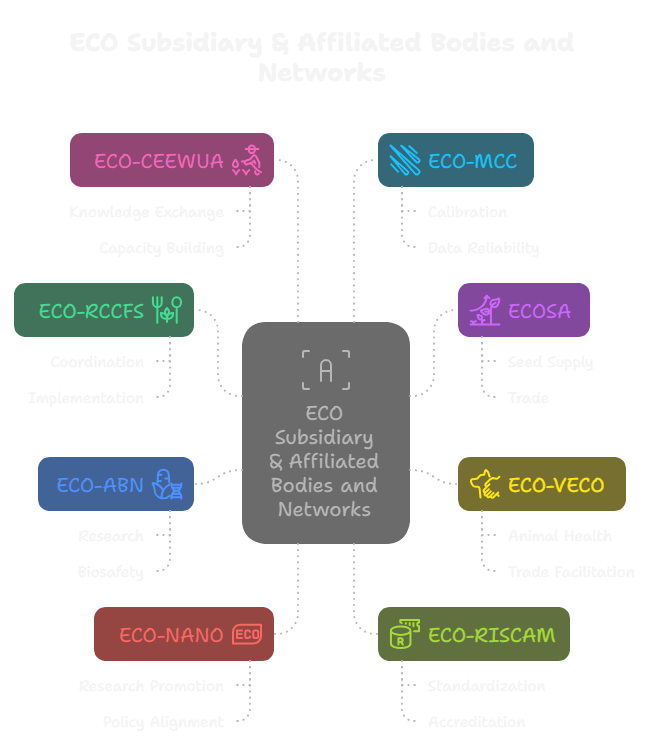
1- ECO Regional Coordination Centre for Food Security (ECO-RCCFS)
ECO-RCCFS, headquartered in Ankara, is a programme-based initiative established to coordinate and implement the ECO Regional Programme for Food Security (RPFS). The Centre was formally launched on 2 November 2012 within the premises of the Ministry of Agriculture and Forestry of Türkiye, following the decision of the 19th ECO Council of Ministers in December 2010.
RPFS, finalized in 2008 through collaboration between the ECO Secretariat and the Food and Agriculture Organization (FAO), aims to enhance food security and agricultural productivity in ECO Member States through sustainable economic and environmental practices. Türkiye was designated as the coordinating country for this initiative during the 20th ECO Regional Planning Council in 2010, taking the lead in implementing the programme across the region.
ECO-RCCFS collaborates closely with the ECO Secretariat and the FAO Subregional Office for Central Asia (FAO-SEC) to harmonize policies and foster regional cooperation. The Centre’s Working Principles and Procedures were adopted at the 2nd Steering Committee Meeting on 16 February 2017 in Ankara, reinforcing its operational framework.
To date, four Steering Committee Meetings have been held, with the latest convened on 6 October 2022 in Istanbul, alongside the Regional Conference on Food Loss and Waste Reduction in Europe and Central Asia. The 5th Steering Committee Meeting is planned for 2025. These meetings are key platforms for strategic direction and coordination among Member States.
ECO-RCCFS is expected to play a vital role in coordinating RPFS activities, promoting regional cooperation and information exchange, engaging stakeholders, raising public awareness, organizing training and workshops, and mobilizing donor support to advance food security across ECO Member States.
For more information, please visit: https://www.ecorccfs.org
2- ECO Seed Association (ECOSA)
Established in 2010, the ECO Seed Association (ECOSA) plays a key role in strengthening seed supply and trade within the ECO region. As an affiliated body of ECO, ECOSA is committed to advancing and improving the seed sector across the region.
In partnership with the ECO Secretariat, ECOSA works to enhance seed sector infrastructure, overcome bureaucratic barriers, and boost agricultural trade. The association focuses on promoting international quality standards and standardizing seed certification and registration systems to facilitate high-quality seed trade and increase agricultural production across the region.
To date, ECOSA has organized eight successful International Seed Trade Conferences. The most recent, the 8th Seed Trade Conference, took place in March 2024 in Taraz, Kazakhstan, with active participation from stakeholders in the seed and agriculture sectors. The 9th ECOSA International Seed Trade Conference is anticipated for 2025, further advancing regional seed cooperation.
Key initiatives currently underway include the completion of the first phase of the Harmonization of Seed Certification Systems project and the near-finalization of the ECO Regional Seed Agreement. Pending final feedback from some Member States, this agreement is set to enhance seed trade and sector development across the region.
In 2025, ECOSA has also initiated a series of online meetings aimed at fostering seed production development within the ECO region. These interactive platforms facilitate valuable information exchange on the current state of seed sectors and investment opportunities across Member States.
For more information, please visit: https://ecosaseed.org/
3- ECO Permanent Veterinary Commission (ECO-VECO)
The ECO Permanent Veterinary Commission (ECO-VECO) was established as a specialized agency in Tehran, following its approval by the 19th Council of Ministers on 22 December 2010. The headquarter of ECO-VECO was inaugurated in 2013 by the Veterinary Organization of the Islamic Republic of Iran.
ECO-VECO aims to promote regional collaboration in veterinary services by strengthening animal health systems, standardizing practices, and supporting trade in healthy livestock and safe animal products in line with international standards. It can play a key role in the development of harmonized frameworks for laboratory accreditation, slaughterhouse operations, quarantine procedures, and health certification within the region.
Since its establishment, three Technical Committee Meetings have been held – two hosted virtually by Azerbaijan (2022-2023) and one by Iran (2024) – focusing on key priority areas such as laboratory and slaughterhouse standards, and animal traceability systems. The 4th Technical Committee Meeting is expected to be organized by Iran in 2025, with planned discussions on laboratory and slaughterhouse standardization, and quarantine frameworks.
Additionally, three Meetings of Heads of Veterinary Organizations have been held, with the 3rd in 2018 in Tehran. The 4th meeting of the ECO-VECO Heads of Veterinary Organizations is also expected to be organized by Iran in 2025.
To support food safety and trade facilitation, ECO-VECO launched a small-scale project to develop a standardized regional network of slaughterhouses and reference laboratories. The outcomes of this initiative, along with the 2024–2028 Work Plan, guide ECO-VECO’s ongoing efforts in technical cooperation, training, and institutional capacity building across Member States.
4- ECO Agricultural Biotechnology Network (ECO-ABN)
The ECO Agricultural Biotechnology Network (ECO-ABN) was established in 2005 in Tehran, following its endorsement by the 2nd ECO Ministerial Meeting on Agriculture held in 2004 in Antalya. The Network is coordinated by the Agricultural Biotechnology Research Institute of Iran (ABRII), affiliated with the Agricultural Research, Education and Extension Organization (AREEO) under the Ministry of Agriculture Jihad of the Islamic Republic of Iran.
ECO-ABN serves as a platform to promote joint research, harmonize biosafety protocols, build institutional capacity, and facilitate information sharing across the region. It connects research institutions, scientists, and policymakers, while also fostering linkages with international organizations and laboratories.
To date, two Expert Group Meetings (EGMs) have been held, with the second convened virtually by Iran in October 2023 alongside a symposium on GMO biosafety and regulation. Member States are encouraged to designate national focal points, share biotechnology-related data, and actively participate in future activities.
At the 35th Regional Planning Council (RPC) Meeting in 2025, Pakistan offered to host the 3rd EGM. Also in 2025, Iran proposed a regional initiative titled ECO Biosafety Capacity Building (ECO-BCB), aimed at evaluating the status of biosafety regulations across Member States, identifying gaps and advantages. The proposal was circulated for Member States’ feedback as part of ECO-ABN’s ongoing efforts to strengthen regional cooperation in agricultural biotechnology.
For more information, please visit: https://ecoabn.org
5- ECO Nanotechnology Network (ECO-NANO)
The ECO Nanotechnology Network (ECO-NANO) was established to strengthen regional cooperation in the development and application of nanotechnology across key sectors such as energy, water, agriculture, environment, and health. The initiative seeks to harness nanotechnology’s potential to enhance quality of life, foster innovation, and support sustainable development throughout the ECO region as well as promotes scientific collaboration and knowledge sharing to address common challenges using advanced technologies.
Within this framework, the Network was officially launched on 26 May 2009 by the Iran Nanotechnology Innovation Council (INIC), which acts as the coordinator. Since its inception, the Network has focused on research promotion, policy alignment, and strengthening cooperation among Member States in the field of nanotechnology.
Under Iran’s coordination, two Steering Committee Meetings have been convened. The first was held on 5 November 2009 in Tehran and focused on establishing priorities and initial actions. The second meeting, conducted virtually on 10 July 2023, reviewed progress and discussed two project proposals: (1) the establishment of nanobubble pilot plants to improve agricultural productivity, and (2) the creation of a coordinating platform for implementing nanotechnology-based water treatment pilot plants. The latter was prioritized due to its practical importance and relevance for the region. Consequently, the 34th Regional Planning Council Meeting in 2024 welcomed the proposed water treatment initiative.
At the 35th Regional Planning Council Meeting in 2025, Iran offered to host the 3rd Steering Committee Meeting and Member States were encouraged to update national nanotechnology reports, increase institutional engagement, and actively support the implementation of the project.
For more information, please visit: http://econano.org/
6- ECO Regional Institute for Standardization, Conformity Assessment, Accreditation and Metrology (ECO-RISCAM)
The ECO Regional Institute for Standardization, Conformity Assessment, Accreditation and Metrology (ECO-RISCAM) was established to promote regional harmonization of standards and support trade among ECO Member States. The decision to establish ECO-RISCAM was adopted at the 3rd ECO Ministerial Meeting on Industry held in Lahore in 2006, and its Statute was endorsed by the 18th Council of Ministers on 9 March 2009 in Tehran.
Headquartered in Tehran, ECO-RISCAM can play a critical role in aligning standards, conformity assessment procedures, accreditation systems, and metrology practices across the region. Its mission is to eliminate technical barriers to trade, enhance product safety and quality, and foster scientific and technological cooperation among Member States. In this context, Member States are encouraged to share national methodologies, designate focal points, actively participate in regional initiatives, and support the establishment of the Institute’s core operational mechanisms to ensure regional alignment and global competitiveness.
ECO-RISCAM operates through four Technical Management Boards (TMBs), covering Standardization, Conformity Assessment, Accreditation, and Metrology. Türkiye is designated to host the TMBs on Standardization and Accreditation, Pakistan on Metrology, and Iran on Conformity Assessment. To support the Institute’s development, nine High-Level Working Group (HLWG) Meetings have been held, with the 9th meeting convened virtually by Iran on 21 November 2023.
At the 35th Regional Planning Council (RPC) Meeting in 2025, Iran offered to host the First General Council Meeting of ECO-RISCAM, pending participation from a quorum of ratifying Member States. This meeting aims to finalize and adopt the Institute’s foundational documents, paving the way for the formal activation of its governance and technical structures. In parallel, Iran plans to host a virtual workshop on Conformity Assessment in 2025, while Türkiye and Pakistan are expected to lead workshops on Standardization, Accreditation, and Metrology, respectively.
For more information, please visit: https://ecoriscam.inso.gov.ir/portal/home/
7- ECO Center of Excellence for Efficient Utilization of Water for Agriculture (ECO-CEEWUA) – Under Establishment
The proposal to establish the ECO Center of Excellence for Efficient Utilization of Water for Agriculture (ECO-CEEWUA) was introduced to address the shared challenges of water scarcity in agriculture. The concept for the Center was initially presented during a regional workshop held in Islamabad in 2006, organized by ECO, FAO, and IDB. At this meeting, the Islamic Republic of Pakistan was tasked with preparing a project proposal for the establishment of the Center. In September 2008, the 4th ECO Ministerial Meeting on Agriculture endorsed the proposal and entrusted Pakistan with leading its development.
To move forward, Pakistan organized the first and second Working Group Meetings in August 2010 and July 2016, which led to the drafting of the Statute and Plan of Action for the Center. The third Working Group Meeting, held virtually in February 2021, finalized the revised documents, which were shared with Member States for feedback.
The Statute of ECO-CEEWUA will enter into force 30 days after the receipt of the fifth instrument of ratification by the ECO Secretary-General. In the meantime, the ECO Secretariat has requested Member States to nominate national focal points to support the establishment process. At the 35th Regional Planning Council Meeting in February 2025, the need to expedite the establishment process was once again emphasized.
Once established and operational, ECO-CEEWUA is expected to play a crucial role in facilitating knowledge exchange, research collaboration, and capacity building in water efficiency for agriculture, making a significant contribution to addressing water scarcity challenges across the ECO region.
8- ECO Meteorological Calibration Center (ECO-MCC) – Under Establishment
The proposal to establish the ECO Meteorological Calibration Center (ECO-MCC) in Ankara as an affiliated body of ECO was approved by the 19th COM in 2010. The Republic of Türkiye has prepared the draft Statute for the establishment of ECO-MCC and is currently awaiting comments and feedback from the Member States to finalize the document.
The draft Statute was initially expected to be finalized during the 3rd Meeting of the ECO Heads of Meteorological Organizations, which took place in November 2019 in Tehran. However, due to the need for further work and improvements, the finalization was postponed.
Looking ahead, the 4th Meeting of the ECO Heads of Meteorological Organizations is anticipated to be held in 2025, as offered by Türkiye during the 35th Regional Planning Council Meeting in February 2025. Member States are encouraged to provide their feedback on the draft Statute of ECO-MCC to facilitate the completion of the finalization process.
Once established, ECO-MCC is also expected play a crucial role in strengthening meteorological calibration efforts within the ECO region, ensuring the provision of accurate and reliable data for effective environmental and agricultural planning.