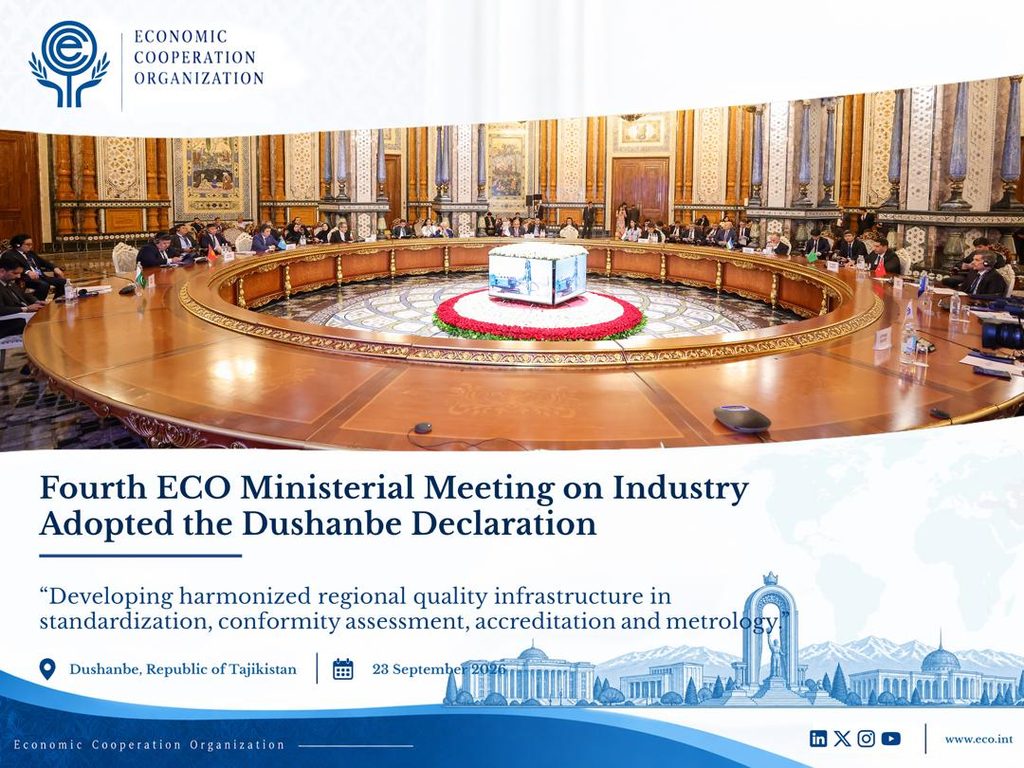
The Fourth ECO Ministerial Meeting on Industry
Dushanbe, Republic of Tajikistan
23 September 2026
We, the Ministers of Industry and Heads of Delegation of the Member States of the Economic Cooperation Organization (ECO), having convened in Dushanbe, Republic of Tajikistan, on 23 September 2026 for the Fourth ECO Ministerial Meeting on Industry,
Reaffirming our commitment to the objectives and principles of the Treaty of Izmir, particularly Article II, which calls for enhancing efforts towards the effective utilization of the industrial potential of the ECO region, as well as the directives of the Quetta Plan of Action and other relevant ECO strategic frameworks;
Recalling the declarations and decisions adopted at the previous ECO Ministerial Meetings on Industry, namely the Tehran Declaration (2004), the Istanbul Declaration (2005), and the Lahore Declaration (2006), and other foundational documents, which have laid the foundation for promoting regional industrial cooperation among ECO Member States;
Acknowledging that two decades have elapsed since the Third ECO Ministerial Meeting on Industry held in Lahore in 2006, and recognizing the need to revitalize regional industrial cooperation through more regular, effective, and result-oriented high-level engagement;
Recognizing the need to address persistent challenges to regional industrial cooperation, including fragmented regulatory frameworks, limited institutional coordination and operational mechanisms, insufficient financial and technical resources, and the absence of a regularly updated network of national focal points across industrial priority areas to enhance coordination and implementation among Member States;
Reaffirming our shared conviction that strengthened regional industrial cooperation will contribute to sustainable economic growth, enhanced resilience, increased competitiveness, and inclusive development across the ECO region;
Recognizing the vital role of industry in driving economic growth and productivity, while noting that the considerable potential for industrial cooperation among ECO Member States is significantly underutilized;
Stressing the importance of developing robust and harmonized quality infrastructure across the region as a key enabler of industrial integration, stronger regional value chains, and increased intra-regional trade;
Acknowledging the transformative potential of artificial intelligence, advanced manufacturing technologies, digital innovation ecosystems and smart industrial solutions in enhancing productivity, competitiveness and industrial resilience across the ECO region, while emphasizing the importance of the responsible and ethical use of safe, secure and trustworthy artificial intelligence for the benefit of the ECO Member States;
Underlining the growing importance of green industrial transformation, resource efficiency, circular economy approaches, Internet of Things (IoT) technologies and environmentally sustainable industrial practices in achieving long-term economic competitiveness;
Recognizing the value of enhanced engagement and cooperation among Member States in agreed priority areas of the industrial sector, including quality infrastructure, nanotechnology, micro, small and medium-sized enterprises (MSMEs), entrepreneurship, and industrial property rights;
Affirming the indispensable role of the private sector, industrial associations, chambers of commerce and investment promotion agencies in advancing regional industrial cooperation;
Underscoring the importance of strengthened partnerships with relevant regional and international organizations in facilitating access to global technical expertise, financial resources, and capacity-building opportunities for industrial development; and
Noting that increased investment and sustainable financing mechanisms are essential for advancing regional industrial initiatives and accelerating sustainable industrial development; and
Recognizing the important role of the ECO Specialized and Affiliated Bodies as institutional mechanisms in promoting capacity-building initiatives and supporting the implementation of regional industrial cooperation;
Do hereby:
- Reaffirm our commitment to revitalizing regional industrial cooperation in line with contemporary global and regional developments, including inclusive and sustainable industrialization, digital transformation, resilient supply chains, innovation-driven growth, and regional value-chain development.
- Reaffirm further our determination to build a more competitive, innovative, resilient and integrated industrial ecosystem across the ECO region for the benefit of our peoples and future generations.
- Welcome the ongoing preparation of the ECO Strategic Goals of Economic Cooperation 2035, in which industry remains a pivotal pillar of economic growth and productivity, and a key regional priority.
- Underline the need to further strengthen regional partnerships among Member States and relevant stakeholders, enhance intra-regional coordination, and ensure regular high-level policy dialogue on industrial cooperation across the region, in order to foster closer collaboration, improve policy coherence, and support the advancement of shared industrial development objectives.
- Task the ECO Secretariat, in close coordination with Member States, to review and consolidate existing strategic instruments and plans of action on industrial cooperation into a consolidated and streamlined ECO Regional Strategy on Industrial Cooperation encompassing all agreed priority areas, aligned with evolving regional priorities and global industrial developments, and serving as the principal regional policy framework for advancing industrial cooperation, for consideration and adoption by the Fifth Ministerial Meeting on Industry; and urge Member States to undertake necessary coordination measures to support its formulation.
- Encourage Member States, subject to their available resources and in accordance with national legislations, to extend financial and technical support for agreed regional initiatives, particularly in the areas of quality infrastructure, nanotechnology, industrial property rights, as well as micro, small and medium-sized enterprises (MSMEs) and entrepreneurship development, with a focus on utilization of innovative and advanced technologies.
- Call upon Member States to take steps, individually and through regional cooperation, based on their available resources and in accordance with national legislation to promote regional industrial integration and connectivity, investment facilitation and technology transfer on mutually agreed terms.
- Urge strengthened cooperation to develop harmonized and robust regional quality infrastructure systems in the areas of standardization, conformity assessment, accreditation, and metrology, as essential instruments for advancing industrial integration, enhancing competitiveness, and expanding regional trade, in accordance with national legislation and the applicable international obligations of Member States.
- Acknowledge the entry into force of the Statute of the ECO Regional Institute for Standardization, Conformity Assessment, Accreditation and Metrology (ECO-RISCAM), and call upon the remaining Member States to expedite the signing and ratification process of the Statute, support the full operationalization of ECO-RISCAM, and facilitate the convening of its First General Council Meeting and the activation of its Technical Management Boards.
- Request Member States to further strengthen regional cooperation in accordance with the mandates of their relevant national institutions in support of micro, small and medium-sized enterprises (MSMEs), public-private partnerships (PPPs), and business-to-business (B2B) cooperation by fostering stronger linkages among enterprises, entrepreneurship support institutions, industrial clusters, innovation ecosystems, industrial associations, chambers of commerce and industry, and investment promotion agencies across the ECO region and to explore the establishment of an ECO Industrial Private Sector Forum to systematically identify and address practical obstacles in related areas.
- Agree to promote cooperation in artificial intelligence, and its responsible ethical, safe, secure and trustworthy use, as well as in advanced manufacturing, industrial digitalization, automation, innovation ecosystems and Industry 4.0 technologies, including through capacity-building and exchange of best practices among Member States as strategic drivers of regional industrial competitiveness.
- Encourage the ECO Secretariat, in collaboration with Member States, to strengthen cooperation with financial institutions, development partners and international organizations to mobilize financial and technical assistance for regional industrial initiatives.
- Invite Member States to organize regular industrial exhibitions and expos, in coordination with the ECO Secretariat, with a view to showcasing the industrial capacities, potential, and opportunities of the region for enhanced industrial cooperation, as well as facilitating networking among relevant stakeholders.
- Urge Member States to nominate and regularly update their national focal points for all identified priority areas of industrial cooperation within the ECO, and to ensure greater national ownership and effective coordination in the implementation of agreed initiatives.
- Encourage the ECO Secretariat to strengthen cooperation with UNIDO, WIPO and other relevant regional and international organizations in promoting industrial innovation, technology transfer, quality infrastructure, digital transformation and capacity-building including the mapping of regional value chains and joint project pipelines in selected industries.
- Express appreciation for the successful convening of the Third High-Level Expert Group (HLEG) Meeting on Industry on 22 September 2026 in Dushanbe, and emphasize the importance of regular meetings of the HLEG and other relevant technical bodies to ensure effective implementation of regional industrial initiatives.
- Emphasize the critical role and importance of intellectual property rights in fostering industrial development and facilitating industrial capacities, technology transfer, sustainable economy, strengthening regional value chains, enhancing innovation and entrepreneurship, developing and commercializing technologies – particularly green technologies – supporting small and medium-sized enterprises, entrepreneurs, inventors, business owners and industrial designers, as well as the necessity of effectively leveraging the capacities of industrial property rights, enhancing connectivity and interaction among intellectual property authorities of Member States, and strengthening regional cooperation in this area with a view to creating a competitive, innovative and entrepreneurial ecosystem.
- Welcome the offer of any interested Member States to host the Fifth ECO Ministerial Meeting on Industry and the Fourth Meeting of the High-Level Expert Group on Industry, with precise dates and venue to be communicated through diplomatic channels.
- Endeavor to convene the ECO Ministerial Meeting on Industry on a regular basis, at least every two years, in order to sustain political momentum and review implementation of agreed commitments.
- Task the ECO Secretariat with monitoring the implementation of this Declaration and reporting progress to the next Ministerial Meeting.
- Commend the staff of the ECO Secretariat for their dedication, professionalism and tireless efforts in advancing regional industrial cooperation and supporting the successful implementation of the Organization’s industrial agenda.
- Express our sincere appreciation to the Ministry of Industry and New Technologies of the Republic of Tajikistan, particularly His Excellency Mr. Sherali Kabir, Minister of Industry and New Technologies, for the excellent organization of the Meeting and his able chairmanship.
- Express our profound gratitude to the Government and the people of the Republic of Tajikistan for their warm hospitality and the excellent arrangements made for the successful convening of this Meeting.
Adopted in Dushanbe on 23 September 2026.