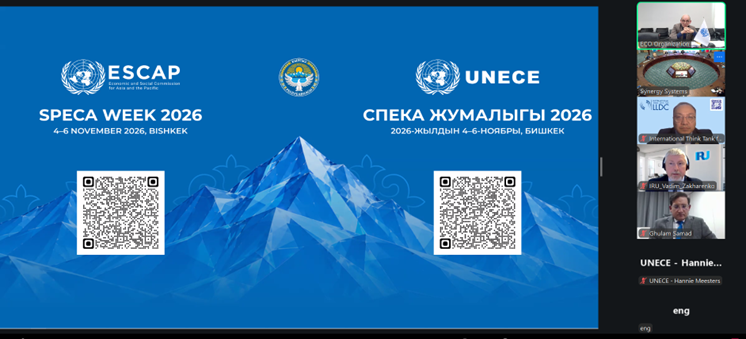
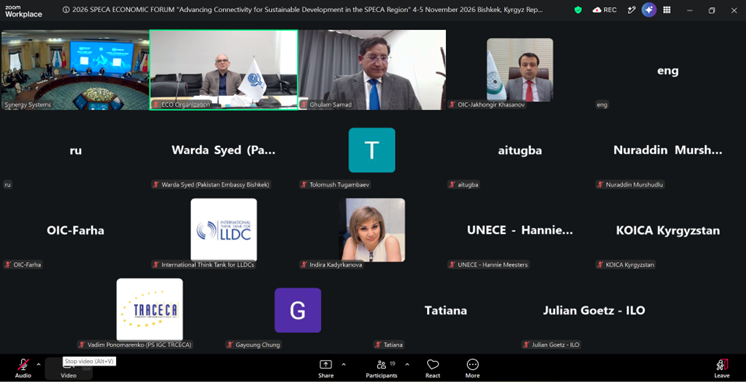
The annual Economic Forum of the United Nations Special Programme for the Economies of Central Asia (2026 SPECA Economic Forum) was hosted by the current SPECA chair country, Kyrgyz Republic, on 4-5 November 2026 in Bishkek. The Forum started with a high-level policy dialogue and continued with 5 sectoral sessions on transport, trade facilitation, SMEs, partnership, and finance.
On 4 November 2026, the ECO Director for Transport and Communications, Seyed Jalaledin Alavi, was among the panelists in the session II of the Forum on “Sustainable Transport Connectivity and Logistics”. In his online presentation and intervention into the panel discussions, the ECO representative briefed the panel on the current state of affairs of the ECO connectivity profile and highlighted the ECO role in regional and global agendas.
He underscored the similarities in the connectivity agendas of both ECO and SPECA as all countries covered by SPECA programme are ECO Member States. He referred to some ECO corridors involving SPECA countries and compared ECO new transport strategy with the SPECA connectivity policy paper developed by the UNECE.
The ECO Director also shared information on the ECO regional activities with global dimension such as implementation of the Awaza PoA where ECO and SPECA common member states are the main beneficiaries. He proposed for a possible transport dialogue between ECO and SPECA with a view to avoiding duplication and synergizing and consolidating the ongoing similar efforts.
The United Nations Special Programme for the Economies of Central Asia (SPECA) was launched in 1998 to strengthen subregional cooperation in Central Asia and its integration into the world economy. The Programme is supported by the UNECE and UNESCAP. The Republic of Azerbaijan, Afghanistan, Kazakhstan, Kyrgyzstan, Tajikistan, Turkmenistan and Uzbekistan are SPECA countries which are also ECO Member States.