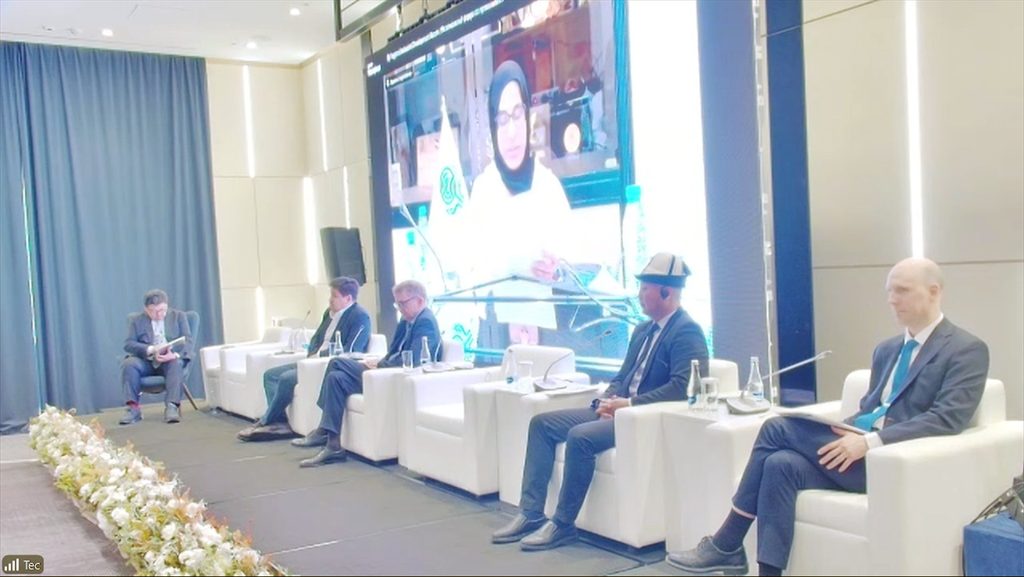
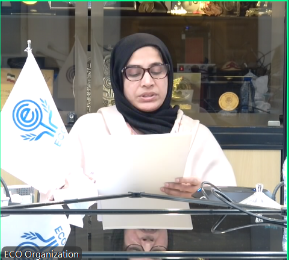
Bishkek, 5 November 2026 – Ms. Amina Batool, representing the Economic Cooperation Organization (ECO), participated online to the Regional Industrial Development Forum held in Bishkek, Kyrgyz Republic, and delivered remarks during Session III – “Regional Exchange: Accelerating Industrial Transformation through Regional Cooperation.”
In her intervention, Ms. Batool emphasized the significant potential for strengthening regional value chains by connecting the industrial capacities and comparative advantages of ECO Member States. She highlighted opportunities for cooperation in sectors such as agriculture and food processing, mining and metals, energy, chemicals, machinery and emerging green industries, underlining the importance of joint production, investment partnerships, technology transfer and stronger business-to-business linkages.
Ms. Batool noted that practical progress in regional industrial integration requires a supportive environment, particularly through more efficient trade facilitation procedures, digital solutions, improved quality infrastructure, and enhanced market access. In this regard, she referred to ECO’s ongoing efforts to advance its Trade Facilitation Strategy and Draft Trade Facilitation Agreement, strengthen regional standards and conformity assessment capacities through the ECO Regional Institute for Standardization, Conformity Assessment, Accreditation and Metrology (ECO-RISCAM), and promote closer economic engagement through the revision of the ECO Trade Agreement (ECOTA).
Referring to the Fourth ECO Ministerial Meeting on Industry, held in Dushanbe on 23 September 2026, she highlighted the 2026 Dushanbe Declaration and its emphasis on regional quality infrastructure, industrial innovation, emerging technologies, digital transformation, MSME development and stronger private-sector partnerships. She also underlined ECO’s ongoing work towards an updated Regional Strategy on Industrial Cooperation, in line with the Organization’s Strategic Goals of Economic Cooperation 2035 (ECO-2035).
Director T& I further stressed the importance of cooperation with international partners, particularly the United Nations Industrial Development Organization (UNIDO), in translating regional priorities into practical initiatives. Recalling the successful ECO–UNIDO regional quality infrastructure cooperation implemented during 2014–2017, she welcomed the planned joint regional project on strategic foresight for the transition towards a circular economy in the ECO region. She noted that such partnerships can contribute to institutional capacity-building, technology upgrading, sustainable industrial development and the creation of new regional value chain opportunities.
Concluding her remarks, she reaffirmed ECO’s commitment to promoting regional cooperation and partnerships that translate the complementary strengths of its Member States into concrete industrial projects, stronger business connections and more competitive regional value chains.